
7 min read
Liposuction or Liposculpture: What Is the Difference?
Classic liposuction, liposculpture, VASER, HD lipo: what distinguishes these techniques, what they do not do, and the recovery timeline up to the final result.
By Dr. Achraf Daoud · Published on · Updated on
Liposuction removes excess localised fat to reduce a volume, whereas liposculpture adds a sculpting dimension: the surgeon redefines the contours of the body and may reuse the harvested fat to reshape other areas. In practice, both rely on the same basic technique, and the difference lies mainly in the aim and the precision sought. In both cases, it is not a treatment for obesity.
This guide explains the techniques, their limits and the timeline of a realistic recovery.
Classic liposuction: the principle
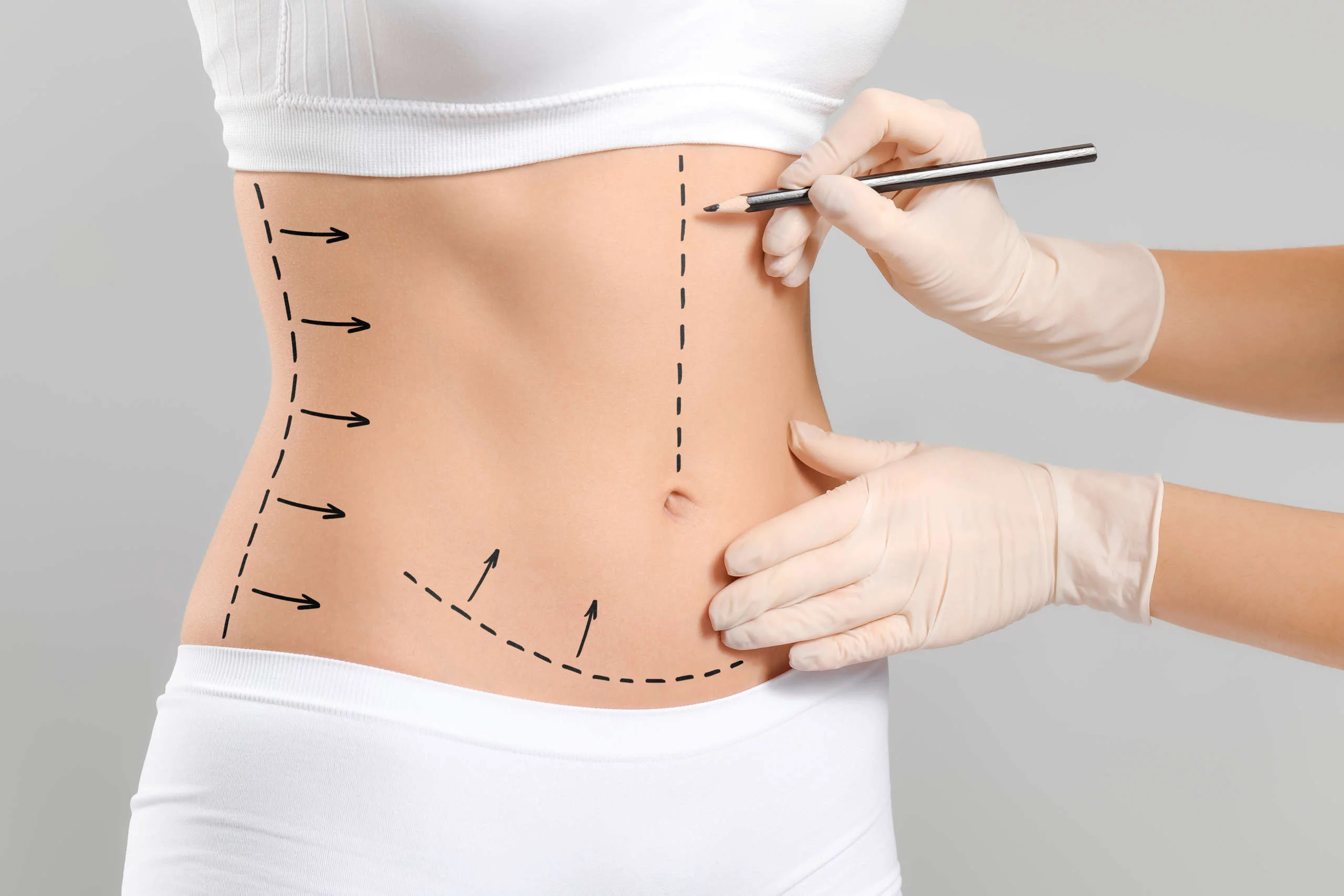
Liposuction treats localised fat deposits that resist diet and exercise, on skin of good quality. Through small incisions of a few millimetres, the surgeon infiltrates a fluid that helps separate the fat cells, then removes the fat with fine cannulas. The fat cells that are removed do not grow back, but those that remain can enlarge if you gain weight.
Liposculpture: sculpting rather than suctioning
The term liposculpture describes a more refined approach. The surgeon is not only trying to remove a volume but to shape the silhouette: slimming the waist, defining the transition between two areas, harmonising the contours. She works the fat at several levels and may deliberately leave a certain thickness of it to preserve a natural appearance.
The fat that is removed can, when it is of good quality, be purified and injected back to reshape another region, for example the buttocks, the face or the breasts. This is known as fat transfer (fat grafting). Part of the transferred fat is reabsorbed, on average around 30 to 40%, which must be taken into account when planning.
| Criterion | Classic liposuction | Liposculpture |
|---|---|---|
| Aim | Reduce a localised volume | Redefine contours and silhouette |
| Precision | Standard | Finer, work at several levels |
| Reuse of the fat | Not usually | Possible (fat transfer) |
| Length of the operation | Varies according to the areas | Often longer |
| Suitable for | Localised fat deposits | Silhouette to harmonise, multiple areas |
VASER, laser, power-assisted: the techniques
Several technologies exist, and none is miraculous. The choice of technique depends on the area, the firmness of the fat and the surgeon's experience.
- VASER: ultrasound selectively fragments the fat before suction, sparing the fibres and blood vessels more. It is useful for fibrous areas (back, flanks) and for detailed contouring.
- Power-assisted liposuction: the cannula vibrates mechanically, which makes it easier to remove larger volumes with less effort.
- Laser or radiofrequency technologies: sometimes used as an adjunct to stimulate skin retraction, with variable benefits from case to case.
- Classic tumescent technique: it remains a reliable and widely proven foundation.
HD (high-definition) liposculpture
HD lipo aims to bring out muscle definition, notably the abdominal muscles, by removing fat in a very targeted way around the muscles. It demands great precision and is aimed at patients who are already slim, with a stable weight and firm skin. It is not suitable for everyone, and its result depends largely on body shape. The aim is not to create muscles, but to show off those that already exist.
Liposuction is not a weight-loss treatment
The amount of fat removed is limited by safety rules: beyond a certain volume the risks increase, and spreading the treatment over several sessions is sometimes necessary. Your surgeon assesses this at the examination.
Which areas can be treated?
- Abdomen and flanks (love handles).
- Saddlebags, hips and thighs (inner and outer).
- Knees, calves and ankles, with caution.
- Back, bra line and arms.
- Chin and neck, with very fine cannulas.
- Male chest (gynaecomastia of fatty origin).
Recovery: compression garment and lymphatic drainage
The after-effects of liposuction are not trivial: bruising, oedema, a feeling of tightness and muscle aches at first. A compression garment is worn day and night for several weeks, generally 4 to 6, to limit oedema and help the skin adapt. Manual lymphatic drainage sessions are often recommended to encourage the oedema to resolve, starting according to your surgeon's advice.
- First days: rest, light walking, compression garment worn at all times.
- Week 1: bruising at its peak, a return to office work may be possible depending on the areas treated.
- Weeks 2 to 4: oedema subsiding, lymphatic drainage begins, normal daily activities.
- Weeks 4 to 6: gradual return to sport with your surgeon's agreement.
- Month 3: the appearance refines markedly, the skin adapts.
- Months 3 to 6: the final result is generally assessed between 3 and 6 months, sometimes longer for fibrous areas.
Skin retraction: the limits of liposuction
After fat removal, the skin has to retract to fit the new shape. This ability depends on age, elasticity, genetics, smoking and previous weight changes. In a patient whose skin is loose or marked by stretch marks after pregnancies or weight loss, liposuction alone may leave excess skin, or even make it more noticeable.
In that case, an abdominoplasty (tummy tuck), which removes excess skin and tightens the abdominal wall, is often more suitable, possibly combined with liposuction. Knowing when to decline liposuction because it is not the right indication is a sign of a serious surgeon.
Possible risks and complications
Like any surgery, liposuction carries risks: surface irregularities or waviness, asymmetry, haematoma, fluid collections (seromas), altered sensation, infection, venous thrombosis, fat embolism and anaesthetic complications. No result can be guaranteed. A consultation with a medical examination determines whether you can safely be operated on and which areas are genuinely suitable.
Liposuction in Tunisia: planning your stay
The number of areas treated and the technique are decided after the medical examination. Plan a stay that allows for the initial checks before your journey home.
Choosing between liposuction, fat transfer and abdominoplasty
The three procedures address different situations. Liposuction suits cases where the problem is excess localised fat on firm skin. Fat transfer is added when the harvested fat can be used to restore volume elsewhere, for example to the buttocks or the face. Abdominoplasty is preferable when the abdomen has excess skin, muscle laxity after pregnancy or following major weight loss.
A combination is sometimes proposed, for example an abdominoplasty with liposuction of the flanks. This decision rests on the examination, the pinch test of the skin and the analysis of the abdominal wall. If the skin is loose, liposuction on its own is not advised. Conversely, an abdominoplasty is unnecessary when only excess fat is involved. A consultation with a surgeon trained in all of these techniques helps avoid the error of wrong indication.
Frequently asked questions
What is the difference between liposuction and liposculpture?
Liposuction aims to remove localised excess fat, whereas liposculpture seeks to redefine the contours with more finesse, sometimes reusing the fat for other areas. Both techniques rely on a similar basic technique.
What is the VASER technique?
VASER uses ultrasound to fragment the fat before it is suctioned, which spares the neighbouring tissues more. It is useful for fibrous areas and detailed contouring, without guaranteeing a result or the absence of after-effects.
Does liposuction make you lose weight?
No, liposuction is not a treatment for obesity or a way to lose weight. It reshapes localised fat deposits in a person whose weight is stable.
When can you see the final result of liposuction?
The final result is generally assessed between 3 and 6 months after the operation, once the oedema has resolved and the skin has adapted. The compression garment and lymphatic drainage support this phase.